Run Renewals as a Work Item, Not a Memory
A recurring Renewal & Reboarding work item turns engagement renewals into visible, scheduled work, and moves the pricing conversation out of tax season.
By Max Ducharme

My old firm was tax-heavy, and the engagement letters usually went out with the return and the invoice. By that point the work was done, so the letter was effectively retroactive. One year we sent two letters, that year’s and the next, so we’d always be a year ahead. Eventually we moved renewals to a quieter time of year entirely.
We used a recurring internal Karbon work item at the client group level to make the renewals visible on the work dashboard alongside all the other work.
Engagements renew or end on a date, and nothing in your Work list tells you it’s coming. If an engagement was set not to renew (or nobody set it at all), the only way to notice it ended is to go looking in the engagements section. In a busy firm, nobody goes looking. Then it’s August, and someone asks, “Weren’t we supposed to renew a bunch of these?” You’ve missed out on the opportunity to raise pricing, add services, and remove any services the client no longer needs.
The fix
Give every active client a recurring Renewal & Reboarding work item, timed to their renewal date.
The renewal sits in Planned all year. (If your statuses jump around the board, fix that first.) When it comes due, it moves to Ready to Start, like the rest of your work items.
Reboarding is what I call onboarding for a client you already have. You activate the new engagement, attach it to the workflows already running, set up work items for any new services, and retire the work you no longer do.
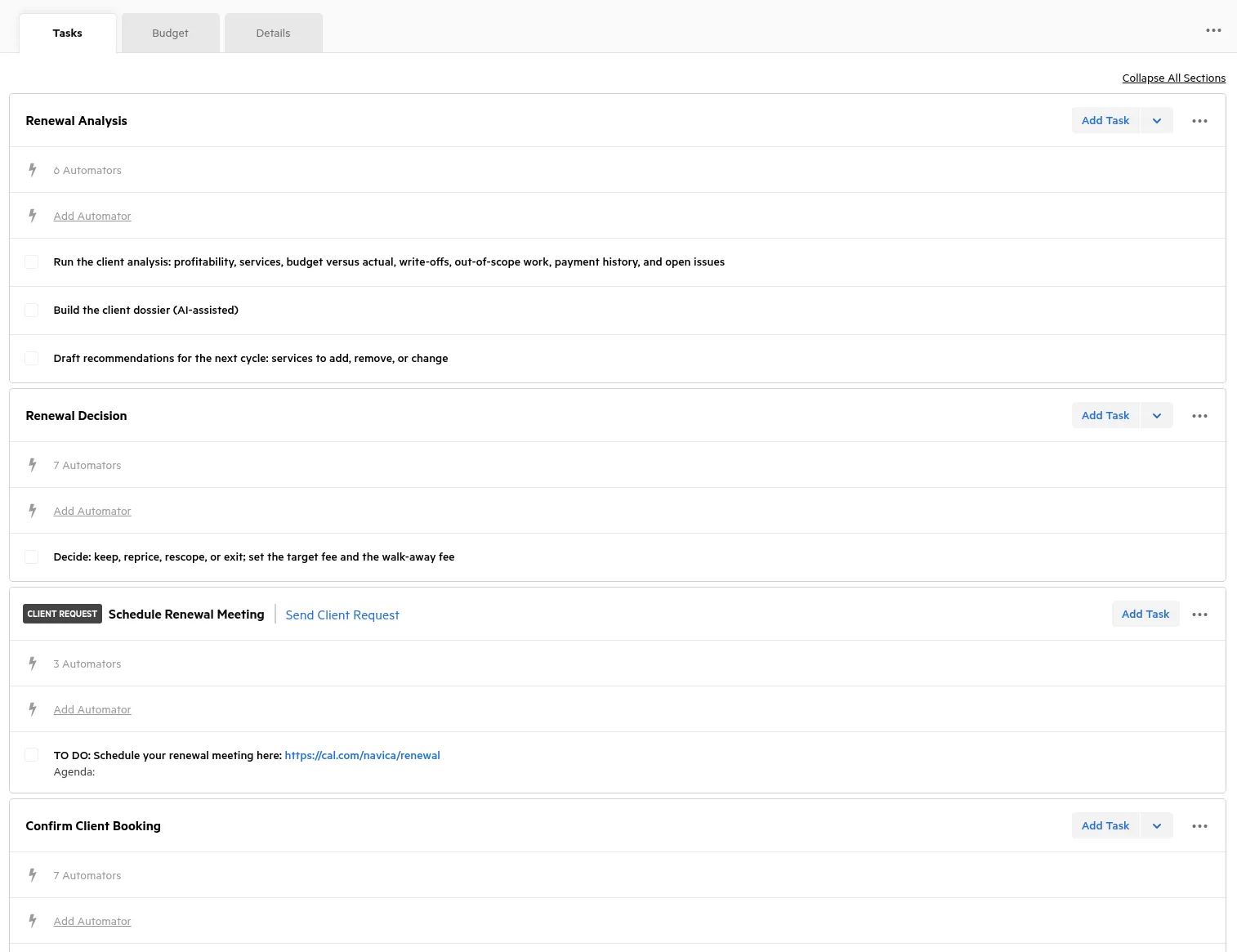
Here’s the top of mine. It starts with a look at the client and an internal decision on the fee, all before the client hears from me.
Why it works
A renewal that’s a work item shows up on your work dashboard next to everything else. You can count how many are coming, see which ones are stuck waiting for a signature, and stop counting on someone to remember.
It also lets you pick when renewals happen. With renewals on their own schedule, the engagement letter no longer has to go out with the return and the invoice.
The quiet months are where the good conversations happen. Nobody sits down in March to discuss a different entity type. Outside busy season, you have room to talk about new services, a better structure, and why the price is going up this year.
What I’d do
- Build a Renewal & Reboarding work template.
- Add the renewal template to every active client on an annual recurrence.
- Vote in The Loft for engagement webhooks. With them, the work item could follow the engagement’s status on its own, and you’d have a live renewal pipeline.
Related
- Karbon now tells you when a signed engagement is waiting
- Engagements now have comments and @mentions
- How to structure statuses in Karbon for a predictable, linear workflow
Brooks and I talk through this in the October episode.
Max Ducharme ran an accounting firm for five years. In that time, revenue more than doubled, and average revenue per employee rose from $89,000 to $150,000. He taught himself Python to build the integrations the firm needed. Today he builds tools that solve the problems accounting firms face now. He is a Six Sigma Black Belt and co-hosts the Working Theory podcast.